

If you have searched “what is ABA therapy” or “ABA therapy for autism” and landed here feeling a little overwhelmed, you are in the right place. ABA is one of the most talked-about therapies for autistic children – and also one of the most misunderstood. This guide explains what ABA therapy actually is, what happens inside a session, and what it can and cannot do for your child.
What ABA Therapy for Autism Actually Is – and Isn’t
ABA therapy for autism is a structured, evidence-based approach to helping children learn skills and build behaviors that make their daily life easier and fuller. It stands for Applied Behavior Analysis – “applied” meaning it is used in real life, not in a laboratory.
The word “applied” is the important one. Unlike basic behavioral science done in a laboratory, ABA is applied directly in real life – in a therapy room, in the home, in a classroom. The goal is always functional: helping a child communicate more effectively, manage daily routines more independently, interact with others more comfortably, and reduce behaviors that get in the way of learning.
What it is not is a one-size-fits-all program. Good ABA therapy starts with understanding who your child is, where their strengths are, and what specific skills would make the biggest difference to their day-to-day life. The goals belong to your child, not to a generic checklist.
It also has the strongest evidence base of any autism intervention – not because it is the only therapy that works, but because it has been studied more rigorously and for longer than any other approach. That matters when you are making a significant commitment of time, money, and hope.
The Story Behind Every ABA Session
Every autistic child has desires. They want to communicate. They want connection. They want to explore the things that interest them. This is true for minimally verbal children, for children who struggle with daily routines, and for children who find social situations overwhelming. The desire is there.
But the way an autistic child’s brain processes, responds to, and learns from the world around them can make those desires genuinely harder to act on without support. A child who wants to ask for water but does not yet have the communication tools to do so will find another way – one that may not work as well for them or for the people around them. A child who wants to participate in a group activity but cannot yet manage the sensory or social demands of it will opt out, not because they do not want to be there, but because they do not yet have what they need to stay.
ABA therapy exists to give children what they need. Not to change who they are, but to build the tools that let them do what they already want to do. Every session, every goal, every small step forward is in service of that one purpose: a fuller, more independent life on the child’s own terms.
This is the logic that runs underneath every ABA session. Once you see it, you will notice it in everything your child’s therapist does.
What Does an ABA Session Actually Look Like?
This is the question most parents ask first – and it is a good one. Here is what a typical session at Avishi Center involves.
Arrival and warm-up (5 minutes) The session starts with a brief warm-up activity the child enjoys. This builds rapport, eases any transition anxiety, and gives the therapist an early read on how the child is doing that day.
Structured skill-building blocks (20 minutes) This is the core of the session. The therapist works on specific target skills from the child’s individual program. These might be communication goals (requesting, labelling, answering questions), daily living skills (dressing, eating independently), cognitive skills, or social skills. Each attempt is recorded as data.
Natural Environment Teaching (15 minutes) Skills are then practiced in a more natural, play-based setting – building blocks on the floor, a pretend kitchen, a ball game. The same skill targets from the structured block are embedded naturally into the activity. This step is what makes skills generalize to real life.
Parent debrief (5 minutes) At the end of the session, the therapist shares what was worked on, what the child achieved, and what to practice at home. Parent involvement is not optional – it is built into the program design.
Sessions are typically 45 to 90 minutes, depending on the child’s age, tolerance, and goals. The entire session is guided by the child’s individual program, which is built from a comprehensive assessment. You can book your child’s assessment with Avishi here.
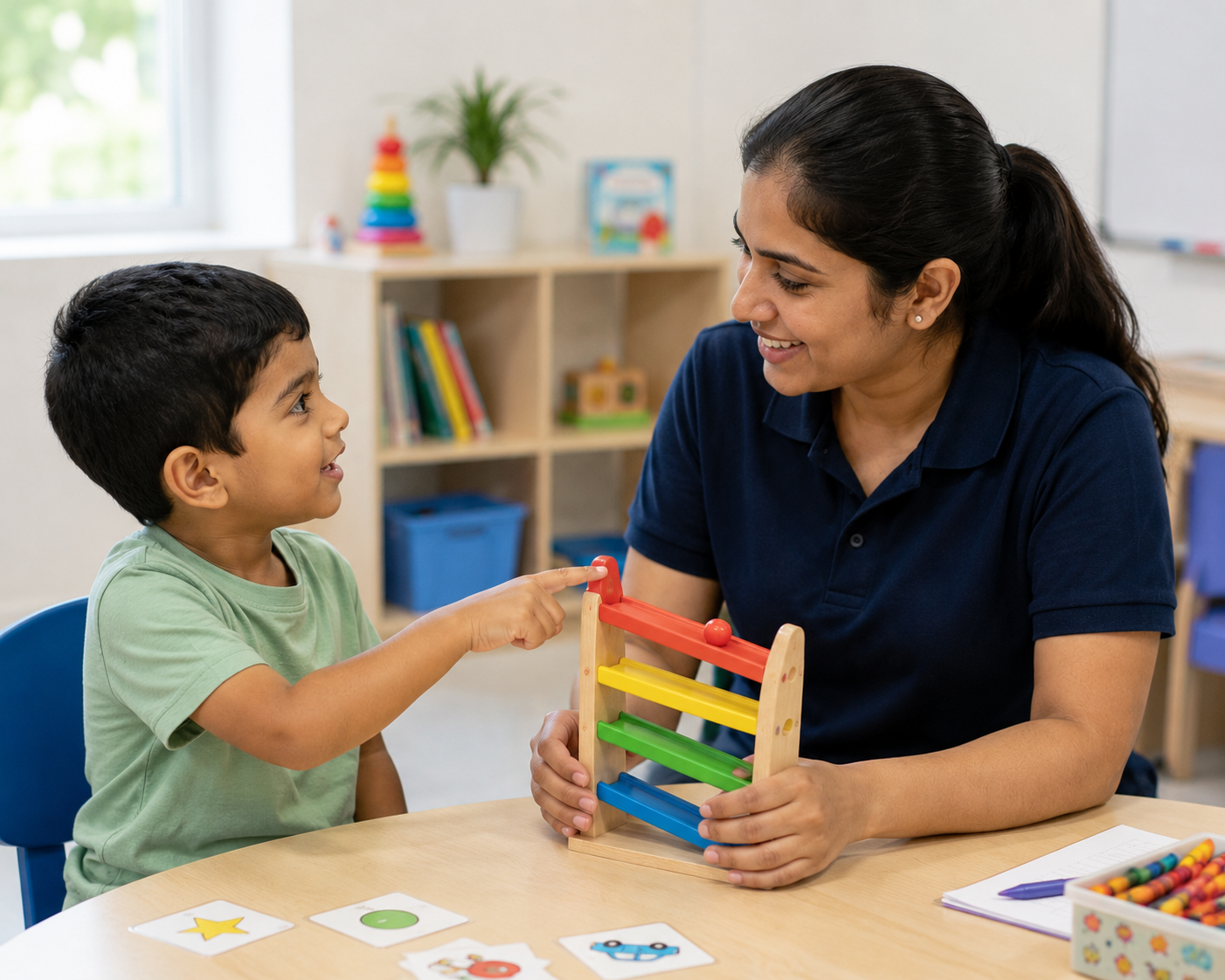
Data is collected throughout the session. Every few weeks, the supervising BCBA reviews that data and adjusts the program. Goals that have been achieved are replaced with new ones. Approaches that are not working are changed. The program moves with the child.
Our ABA therapy in Bangalore is supervised by Akhila, our clinical lead, who holds both BCBA and QBA certifications – the gold standard in behavior analysis practice globally.
The Three Core Techniques Used in ABA Therapy For Autism
Understanding these three terms will help you follow conversations with your child’s therapist and ask more informed questions.
Discrete Trial Training (DTT)
DTT is a structured teaching method where a skill is broken into very small steps and practiced in a controlled, repeated format. The therapist presents a clear instruction, the child responds, and the therapist provides feedback – a correct response earns a meaningful reward, an incorrect response is gently corrected and tried again.
DTT is effective for teaching new skills where a child needs repeated practice to build the neural pathway – things like matching, identifying objects, following two-step instructions. It is one tool within ABA, not the whole of it.
Natural Environment Teaching (NET)
NET embeds the same skill targets into everyday activities and play. If DTT is the classroom, NET is the playground where the child proves they can use the skill in the real world. A child who learned to request “ball” at a table in DTT now needs to request it spontaneously during play – that is NET.
Verbal Behaviour (VB)
Verbal Behavior is a framework within ABA, developed from the linguist B.F. Skinner’s analysis of language, that treats communication as a behavior to be taught systematically. Rather than just teaching a child to name things, VB teaches the different functions of language – requesting (manding), labelling (tacting), repeating (echoics), and conversational exchange (intraverbals). This is why an ABA-trained speech therapist can achieve more for a non-verbal or minimally verbal child than a language-skills-only approach.
What ABA Therapy for Autism Can Address
ABA is not limited to any one domain. At Avishi Center, our ABA therapy in Bangalore addresses skills across a wide range of areas depending on what each child needs most:
- Communication — requesting, labelling, answering questions, initiating conversation, using AAC devices
- Social skills — joint attention, turn-taking, play with peers, reading social cues
- Daily living skills — dressing, hygiene, feeding, toilet training, household routines
- Cognitive and pre-academic skills — matching, sorting, sequencing, early literacy and numeracy concepts
- Behaviour reduction — understanding and reducing behaviours that interfere with learning or safety, by identifying their function and teaching alternative skills
- Emotional regulation — recognising and managing feelings, tolerating transitions, coping with change
Goals are never chosen arbitrarily. They come directly from a comprehensive assessment and are set collaboratively with the family.
Have Questions? We’re One Message Away
Every child is different, and ABA therapy for autism is different for each child. The most useful conversation you can have is a specific one about your child.
WhatsApp us directly – tell us about your child and we will help you figure out whether ABA therapy is the right next step. Or call us at +91-89716 57082
Who Delivers ABA Therapy For Autism – Qualifications Matter
In India, the title “ABA therapist” is unregulated – meaning anyone can use it. This makes qualifications a critical thing to ask about before enrolling your child anywhere.
Here is what to look for:
BCBA (Board Certified Behavior Analyst) – the global gold standard for behavior analysis. A BCBA has a master’s degree, thousands of supervised practice hours, and has passed a rigorous international exam. A BCBA should be supervising every ABA program your child receives, even if they are not in the room for every session.
QBA (Qualified Behavior Analyst) – an additional certification from the Qualified Applied Behavior Analysis Credentialing Board, held by practitioners who meet further competency standards beyond the BCBA.
ABAT (Associate Behavior Analyst Technician) – the qualification held by behavior technicians who implement sessions under BCBA supervision.
At Avishi Center, our clinical lead Akhila holds both BCBA and QBA certifications, along with an MSc in Psychology and supervised fieldwork hours. Every program is designed under her direct supervision.
Is ABA Therapy for Autism the Right Fit for My Child?
ABA therapy for autism is appropriate for a wide range of children on the autism spectrum – from minimally verbal toddlers to verbal school-age children who need support with social communication, self-regulation, or adaptive skills. It is also used effectively alongside speech therapy, occupational therapy, and special education. Many children at Avishi receive multiple therapy modals.
The best way to answer this question for your specific child is a proper assessment first. A comprehensive assessment tells you where your child’s skills currently are across all domains, what the priority goals should be, and what therapy intensity and approach will serve them best. Jumping into therapy without an assessment is like building a house without a blueprint.
If you are in Bengaluru and would like to understand whether ABA is the right fit, you can book a comprehensive assessment at Avishi Center – a structured, multi-domain evaluation conducted by our BCBA-supervised team.
We also offer the Foundation Skills Program for children working toward school readiness, and an After School Program for school-going children who need structured support in the afternoons.
Frequently Asked Questions (FAQs)
Is ABA therapy harmful to autistic children?
No. Contemporary BCBA-supervised ABA is child-led in its pacing, uses only positive reinforcement, and focuses on building skills that improve quality of life on the child’s own terms.
How many hours of ABA therapy does my child need per week?
Quality of supervision, parent involvement, and how well goals are individualized matter enormously alongside intensity. Many children benefit from 10–15 hours per week of high-quality, well-supervised therapy combined with strong parent training and home generalization. Your child’s assessment will recommend an appropriate intensity based on their profile and goals.
What is the best age to start ABA therapy?
The research consistently shows that earlier is better – the 18-month to 5-year window is considered optimal because of brain plasticity during this period. That said, ABA is not age-limited. Children who start at 6, 8, or even older can make meaningful progress, particularly on functional life skills, communication, and self-regulation. The right answer is: start as soon as you have a clear assessment of your child’s needs, regardless of their current age.
Does ABA therapy teach children to mask or suppress who they are?
This is a fair and important question. Poor ABA practice has historically tried to make autistic children appear neurotypical – suppressing stimming, forcing eye contact, demanding social performance at the cost of the child’s wellbeing. Good ABA practice does none of this. The goal is to build skills that give the child more choices and more independence – to communicate their needs, navigate their environment, and participate in the world in a way that works for them. Stimming that is not harmful is not a target for reduction. Identity is not a problem to be solved.
How is progress measured in ABA therapy for autism?
Every session generates data. Therapists record how the child responded to each learning trial – correct, incorrect, prompted, or unprompted. This data is reviewed regularly (typically every 4–6 weeks by the supervising BCBA) to assess whether a skill has been acquired, whether a goal needs to be adjusted, and whether the teaching approach is working. This is what makes ABA accountable in a way that most other therapies are not.
How long does ABA therapy typically take?
There is no universal answer. Some children achieve their goals in 12–18 months of focused therapy. Larger functional changes typically take months of consistent therapy and home practice. The timeline depends on the child’s age, the intensity of therapy, the goals being targeted, and how actively the family is involved in generalizing skills at home. Others benefit from ongoing support for several years, with goals evolving as the child develops. The key is regular program review – goals should not stay static once achieved. A well-run ABA program is always moving forward.
Is ABA therapy for autism the same everywhere?
No – and this is important. ABA is a framework, not a fixed product. The quality of an ABA program depends almost entirely on who supervises it. A program supervised by a BCBA, built from a proper assessment, with regular data review and parent involvement looks very different from one that is not. Before enrolling anywhere, ask who supervises the program, what their qualifications are, and whether you can observe a session.
Will ABA therapy change my child’s personality?
No. ABA therapy for autism builds skills – it does not reshape identity. Stimming that is not harmful is not a target for reduction. Your child’s interests, quirks, and way of being in the world are not problems to be solved. The goal is for your child to have more tools, more choices, and more ways to participate in the life they want – as themselves.
Does ABA therapy work for older children, not just toddlers?
Yes, with caveats. While early intervention (before age 5) produces the fastest gains because of brain plasticity, ABA therapy for autism is not age-limited. Goals shift as children grow – from foundational communication at age 3 to independent daily living skills at age 10 to vocational and social skills in adolescence. The approach adapts but early intervention is most fruitful.
How is Avishi’s approach different from standard ABA therapy for autism?
Every program at Avishi is built from a comprehensive multi-domain assessment, supervised directly by a BCBA and QBA-certified clinical lead, and reviewed against data on a regular cycle. We do not use a generic curriculum applied to all children. We do not use punishment or aversive techniques. We include parent training as a non-negotiable part of every program.
Ready to Take the Next Step?
The best thing you can do for your child right now is get clarity. A comprehensive assessment at Avishi Center gives you a full picture of where your child’s skills currently are, what the priorities should be, and what ABA therapy for autism will actually look like for them specifically.
Find Us on Google
Avishi Center – ABA and Speech Therapy Bangalore Poorna Prajna Layout, Uttarahalli, Bengaluru, Karnataka – 560061 📞 +91-89716 57082 🌐 avishicenter.com
Avishi Center offers BCBA and QBA-supervised ABA and speech therapy at our centre in Uttarahalli, Bengaluru. If you would like to understand what therapy could look like for your child, the right first step is a comprehensive assessment. Book here.